How Much Weight Can Mule Tape Hold?
Estimated 0 min read
It is one of the most common questions we hear. Somebody picks up a reel of mule tape, sees 2,500 lb printed on the label, and asks whether it will hold 2,500 pounds. The answer is that the number is real, but it does not mean what most people picture. That rating is the breaking strength of brand new tape in a straight, clean pull. It is not a promise that you can hang 2,500 pounds from it or treat 2,500 pounds as your everyday working load. Real pulls happen in dirty conduit, around bends, with knots in the line and edges doing their best to chew through it. Once you understand what that number actually measures, the ratings make a lot more sense, and your pulls go better.
A quick disclaimer before we go any further: we do not recommend using pull tape for anything other than what it’s designed for - pulling cables and wires through conduit. What you do is none of our business, but pull tape is not rated for hanging, securing, tie-downs, or towing.
What does the number on the reel actually mean?
Every rating on our mule tape, 1,250 lb, 1,800 lb, 2,500 lb, and 6,000 lb, is a tensile breaking strength. That means a new piece of tape, held straight in a test setup with no knots, no bends, and no damage, was pulled until it failed, and the rating is the load it reached. Nothing on a jobsite looks like that test. Your tape has a knot or a pulling grip on one end. It runs around bends. It rubs on conduit edges. It may have spent the summer riding around in a hot truck. Each of those things takes something off the top, which is why experienced crews treat the printed rating as a ceiling to stay well under, not a target to aim for. Pull tape goes by a few names, mule tape, flat rope, mule line, and cable pulling tape, but the rating works the same way on all of it.
Similarly, if you’re using mule tape as an inexpensive line to get things done around your property, you need to be aware of the limits. Pull tape is not designed for this type of use, hence its lack of working load limit. And while we don’t endorse using it for anything but its intended use, we don’t ask when you buy it. Real world use almost always involves uneven force, knots, edges, or similar issues. The usual way to calculate a safe working load limit is by dividing the breaking strength by a safety factor based on use and risk. For example, a common safety factor for any type of lifting or rigging is a 5, so a rope with a breaking strength of 2,500 lb would have a safe working load limit of 500 lbs (2,500/5). Knots, age, previous use, etc, all should inflate that safety factor, reducing SWLL.
Why isn't pulling tension the same as cable weight?
This is where most of the confusion lives. When you pull cable, the tape is not carrying the weight of the cable the way a hoist would. It is overcoming friction. On a short, straight run of clean conduit, a cable weighing a few hundred pounds might take only a fraction of that weight in pulling tension to keep it moving. Put that same cable through a long run with two or three bends and the tension climbs fast, because every bend multiplies the friction from the section before it. By the end of the run, the tension at the pulling end can be several times higher than where the cable entered. Dried mud in the duct, a damaged section of pipe, or cable that has taken a stiff set from sitting on the reel all push the number higher still.
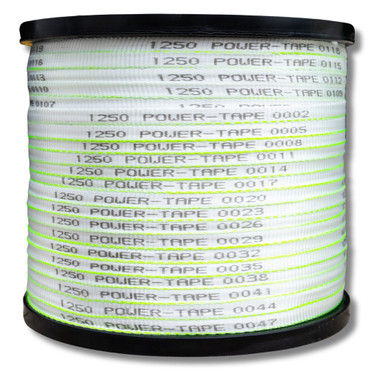
How you pull matters just as much. A steady, even pull keeps tension close to what the run actually requires. Jerking and snatching at the line sends shock loads through the tape that spike far above the steady tension, and those spikes are where tape lets go. It is one reason our pull tape is pre-lubricated and woven from low stretch polyester. The lubrication lowers friction inside the conduit, and low stretch means the tape does not store energy like a rubber band and hand it all back at once. The footage markings printed every foot help as well, since knowing how much tape is in the run tells you a lot about what the pull should feel like.
What else cuts into that strength?
Knots are the biggest single thief. Any time you tie a knot in tape, the tight bends inside it concentrate the load on a small share of the fibers, and the tape starts failing right there. Depending on the knot, you can lose a third of the strength or more, and some knots cost closer to half. That is worth remembering when the printed rating starts to feel generous. A 2,500 lb tape with a knot in it is not a 2,500 lb line anymore, and it never tells you exactly what it has become.
Edges and abrasion do quieter damage. Tape dragged across a sharp conduit edge, a rough bell end, or broken concrete gets cut a few fibers at a time. Fraying, nicks, and glazed spots where the tape ran hot under friction all mean the full rating no longer applies. Age does the same work slowly. This is why pull tape is considered disposable - use once and toss it. The risk of breaking a pull tape and the headache involved significantly outweigh the cost of just using fresh tape for each pull.
What are the four ratings realistically good for?
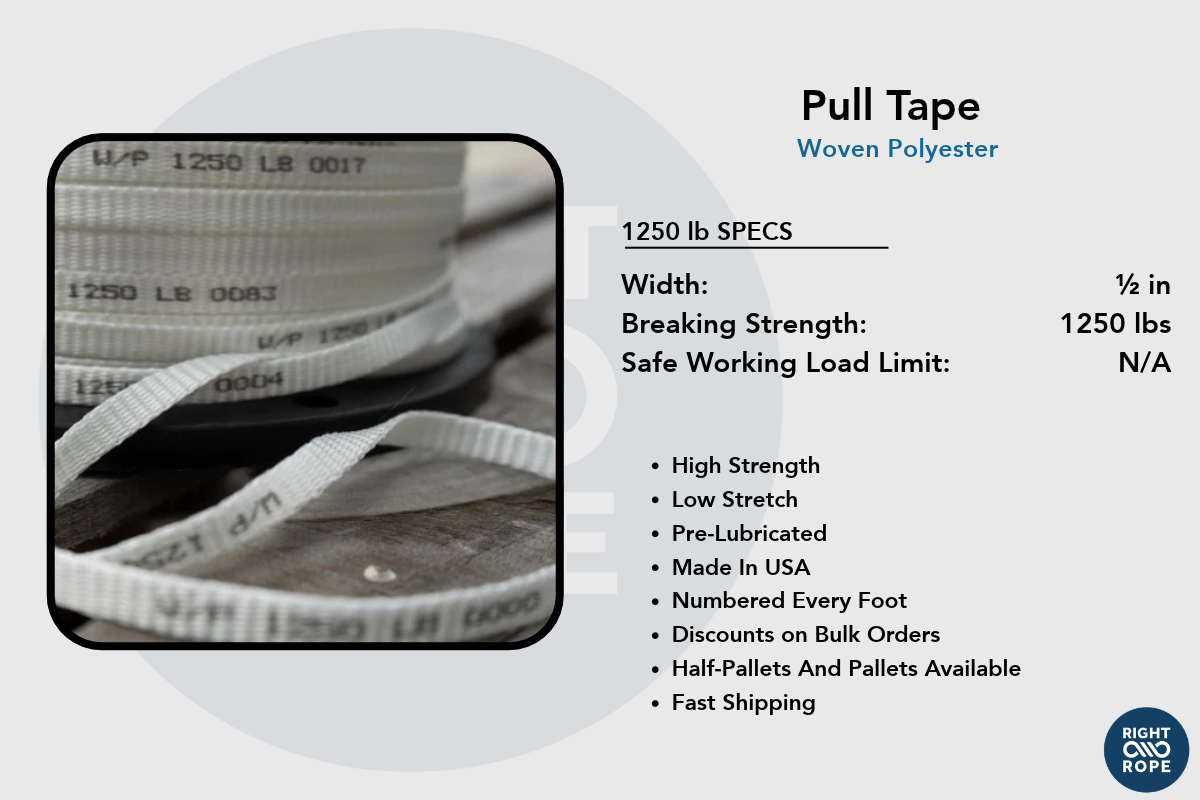
Here is how the four ratings we sell shake out in the real world. The 1,250 lb tape, at 1/2 inch wide, handles light pulls, meaning small cable in short, reasonably straight runs where tension stays modest. The 1,800 lb tape at 5/8 inch is the everyday middle of the road, sized for general conduit pulls with bends in the run and tension that is harder to predict. The 2,500 lb tape at 3/4 inch steps up to heavier feeders, longer runs, and pulls where friction is going to build. The 6,000 lb tape at 1-1/4 inch is built for the heavy end of the work, big duct banks and long, hard pulls where tension runs high and there is no room for guessing.
Utility crews also put pull tape to work as a pilot line, running it through a duct first and using it to pull a larger pulling rope in behind it. That job shows what the ratings are really for. The tape is not carrying a load anywhere near its rating. It is surviving friction, edges, and distance with strength to spare. Picking between the four comes down to the run you are pulling, not just the cable waiting behind you. Our woven polyester pull tape covers all four ratings, and for the full breakdown of which strength fits which job, see our guide to choosing pull tape strength. The rule that never changes is simple. Stay well under the rating and the tape will treat you right.
We also carry a detectable pull tape in the 1,250, 1,800, and 2,500 lb ratings, with a 22 gauge copper coated conductor woven in so the line can be found later in non-metallic duct. The conductor is there for locating, not for strength, so everything we just covered applies to it the same way.
Questions we hear about mule tape strength
Can I lift something overhead with mule tape?
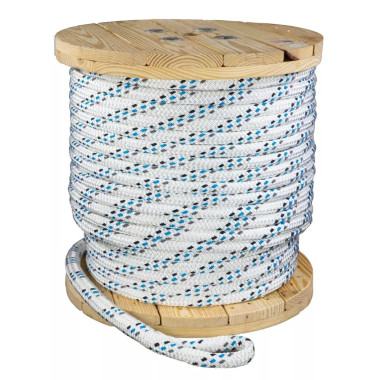
No - this is not a recommended use for Pull tape. Pull tape is made for pulling cable through conduit, and its rating is a breaking strength, not a lifting rating. Overhead lifting puts people under loads and calls for slings and hardware that are rated, tagged, and inspected for that work. Nothing sold as pull tape belongs in overhead lifting, rigging, or any life safety job, no matter what the number on the reel says. Of course we can’t stop you from buying it if that’s what you want, but we would recommend a solid braid polyester rope (cheaper but weaker) or double braid polyester (more expensive, stronger) for this kind of task.
Does a knot really cut strength that much?
Yes, and it surprises people. The fibers on the outside of a tight bend carry far more of the load than the fibers on the inside, so the tape starts to fail at the knot long before the straight sections are close to their limit. Losing a third is common, and losing half is not unusual with the wrong knot. If you have to tie in or attach to a pulling eye, treat the rating as already reduced and size up when the pull matters.
Can I use mule tape to tow a vehicle or tie down a load?
We would not. Towing and recovery bring shock loads that spike every time slack comes out of the line, and tie downs need rated hardware and a working load limit you can point to. Mule tape has neither. It is genuinely strong at the job it was built for, pulling cable, and using it outside that job asks a flat strip of woven polyester to do work it was never tested for. Here’s our blog about the best towing ropes, and some recommended options for tie down ropes.
When should I retire a reel of pull tape?
We recommend you use pull tape once, and then toss it. It’s cheap enough to do so. But we also know not everyone will do that. Retire any section with visible cuts, heavy fraying, crushed or glazed spots, or stiffness that was not there when the tape was new. Retire tape that survived a snapped pull or a hard overload, even if it looks fine, because the damage is not always visible. And be honest about reels with no history. If nobody knows where a reel has been or what it has been through, starting fresh on a pull that matters is cheap insurance.
Ready to put the right rating to work?
If your next pull deserves mule tape you can trust, take a look at our woven polyester pull tape. Every reel is made in the USA, pre-lubricated, printed with sequential footage markings every foot, and wound on a heavy duty plastic reel built to survive the truck and the jobsite. Pick the rating that gives your pull honest working room instead of the one that barely covers it. If you are not sure which strength your run calls for, get in touch with us. We would rather help you size it right than hear about a pull that went sideways.