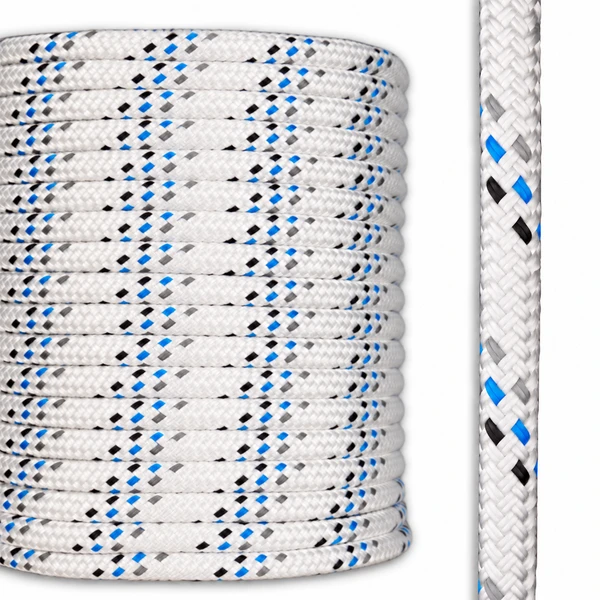
A 100% polyester double braid bull rope (rigging line) with very low stretch. For pulling trees and rigging limbs. Can be spliced.



- U.S. orders placed by 3 pm ET on a business day ship the same day. We're closed weekends and a few holidays.
- Our average rating across all Right Rope products, from 900+ verified reviews. Read reviews (opens in a new tab)
- This product is made in the United States.
Great for
- Strong, with low stretch and a long service life.
- Soft, flexible and easy to handle.
- Polyester stretches much less than nylon.
Another rope to consider

Specs
See all sizes
| Diameter | Weight (Lbs / 100 Ft) | Breaking Strength (Lbs) | Safe Working Load Limit (Lbs) |
|---|---|---|---|
| 3/8 | 4.5 | 5000 | 417 - 1000 |
| 7/16 | 5.9 | 7500 | 625 - 1500 |
| 1/2 | 8.2 | 10000 | 833 - 2000 |
| 9/16 | 10.3 | 16000 | 1333 - 3200 |
| 5/8 | 12.2 | 18000 | 1500 - 3600 |
| 3/4 | 18.2 | 26000 | 2167 - 5200 |
| 7/8 | 26.5 | 32000 | 2667 - 6400 |
| 1 | 32.8 | 42000 | 3500 - 8400 |
How it holds up
- StretchVery low
- Rot and mildewExcellent
- SunExcellent
Description
Our Double Braid Arborist Bull Rope is made in the USA from 100% high-tenacity polyester: a braided core inside a braided jacket, also called braid on braid. That build is typically the strongest way to make a rope, and it's torque-free, so it won't hockle or kink, and it splices easily. Polyester gives it very low stretch and strong resistance to wear, sun, rot, mildew, marine growth, chemicals and oil, for a long service life pulling trees and rigging limbs. It's the step up from our 3 Strand Arborist Bull Rope for more strength with low stretch. For shock-loading, step up to a rope with a nylon core: TreeBLITZ, V-HEX or Husky.
- Sizes 3/8 in to 1 in. The same rope as our Double Braid Polyester Rope, which comes in 3/16 in to 1 in
- Soft, flexible and easy to handle
- Meets or exceeds Cordage Institute specs for high-performance rope
- Use a 5 to 1 safety factor: divide the breaking strength by 5 for the working load limit
- White with black, blue and gray tracers
Questions
About the rope
What is double braid?
It has a braided core inside a braided jacket, also called braid on braid. Both are high-tenacity polyester here. The construction is torque free, so it will not hockle or kink, and it can be spliced easily.
Is it the same as your Double Braid Polyester Rope?
Yes. It is the same rope. That page also has smaller sizes, from 3/16 in to 1 in. This bull rope page covers 3/8 in to 1 in.
What colors does it come in?
White with black, blue and gray tracers.
Does it meet any standards?
It meets or exceeds the Cordage Institute specifications for high-performance ropes.
Choosing a bull rope
Should I buy polyester or nylon?
Polyester has better abrasion and UV resistance than nylon, and much less stretch. For a low-stretch, durable rope, choose this polyester.
Nylon is slightly stronger but much more elastic. For a high-stretch rope, choose Double Braid Nylon.
What are the stronger options?
For a stronger rope that allows shock-loading, look at ropes with a polyester jacket and a nylon core: TreeBLITZ (Great), V-HEX (Better) and Husky (Best).
Strength and safety
How do I work out the working load limit?
We recommend a 5:1 safety factor. Divide the breaking strength for your diameter by 5. Do not exceed that working load limit.
Breaking strength is the force that breaks new rope under perfect conditions. The working load limit is what the rope can handle in real use without damage. Going over it can weaken the rope in ways you may not see right away.
Where a failure could cause certain injury or death, use a safety factor of 12. The less ideal the use, the higher the factor should be.
Do knots weaken the rope? What about splices?
Yes. A bowline or clove hitch can reduce breaking strength by about 40%. Some knots reduce it by up to 60%. A figure-eight is the best choice, at about 25%. Raise the safety factor to allow for this.
A well-made eye splice keeps 85 to 95 percent of the rope's strength, especially with a thimble. If you have doubts, speak with a seasoned professional.
More help
How do I choose the right rigging rope?
Our 2 minute video gives more guidance on how to choose the right rigging rope for your tree work.
How does a safety factor work out in real numbers?
The safe working load limit (SWLL, or WLL) is typically the breaking strength divided by 5. The more dangerous the use, or the less ideal the use of the rope, the higher the safety factor should be.
Working out your safety factor and SWLL takes some experience, the ability to recognize real-world physics, and knowing the history of your rope.
Here is one example, a 1 inch piece of HMPE rope with a breaking strength of 110,000 lb:
- Low-danger operation, safety factor 5: up to 22,000 lb (110,000 divided by 5)
- A failure would be catastrophic, such as causing certain injury or death, safety factor 12: 9,166 lb (110,000 divided by 12)
- That same piece of HMPE used for a low-risk operation, but with a figure-eight knot on a bight (non-ideal use of the rope), should have a safety factor of more like 7, putting SWLL at 15,700 lb
What happens if I go over the working load limit?
If you stay at or under the SWLL, you have a much lower chance of a break, which means a much lower chance of an accident.
Exceeding it may weaken or damage the rope, often in ways that are not immediately obvious. The more often you exceed it, the easier it will be to break the rope. Respecting the working load limit is one of the most reliable ways to avoid accidents and get the most out of your gear.
Why do knots weaken rope, and when is a splice better?
Many rope users don't realize that knots reduce rope strength significantly. Knots create sharp bends and friction points that concentrate stress on the rope fibers. Some knots slip under load, and others can jam so tightly that they damage the rope permanently. Make sure if you are using any knots that you factor that in to your SWLL, increasing the safety factor by a representative amount.
In heavy rigging, lifting and towing, splices are much safer because they preserve most of the rope's original strength. A well-made eye splice maintains 85 to 95 percent of the rope's strength, especially when paired with a thimble to maintain proper bend radius.
Rope safety means knowing which knots to use, when a splice is the better option, and how different tying methods affect load capacity. If you have doubts about your ability to calculate the proper SWLL, speak with a seasoned professional, and err on the side of caution.